
January 8, 2026
The Social Inversion: Why We Don't Need a New Social Network
By jrf
Social has never been a stable product category. It keeps reinventing itself on top of the same primitive: a person, a website, and the ability to read and write on the internet.
The Protosocial Era
The early web had it right. Blogs weren’t just static posts; they were living nodes. They had authors, commenters, profile blurbs, and entire communities stitched together by hyperlinks. Every blog was a protosocial network.
Then platforms arrived to formalize the pattern. Facebook gave us the structured profile and the “wall.” But the real shift happened with the News Feed. This was an inversion: instead of visiting everyone else’s page, all the updates were pushed to you.
From Topics to Squares
Twitter and Reddit changed where social happened. Reddit shifted the focus to topics, while Twitter became the “Public Square.” Both felt like parks or marketplaces—places of free association and accidental magic.
Fast-forward to today, and everything has converged on the same abstraction. We expect a user’s “presence” to consist of structured text, links, an identity, and read/write surfaces. The form factor is stable because it’s familiar. If you drift too far, users get confused. If you stay too close, you inherit all the limitations of incumbents: the noise, the feeds, and the lack of structure.
The Marqui Inversion
This is where Marqui lives. It is social, but oriented around you, not the feed.
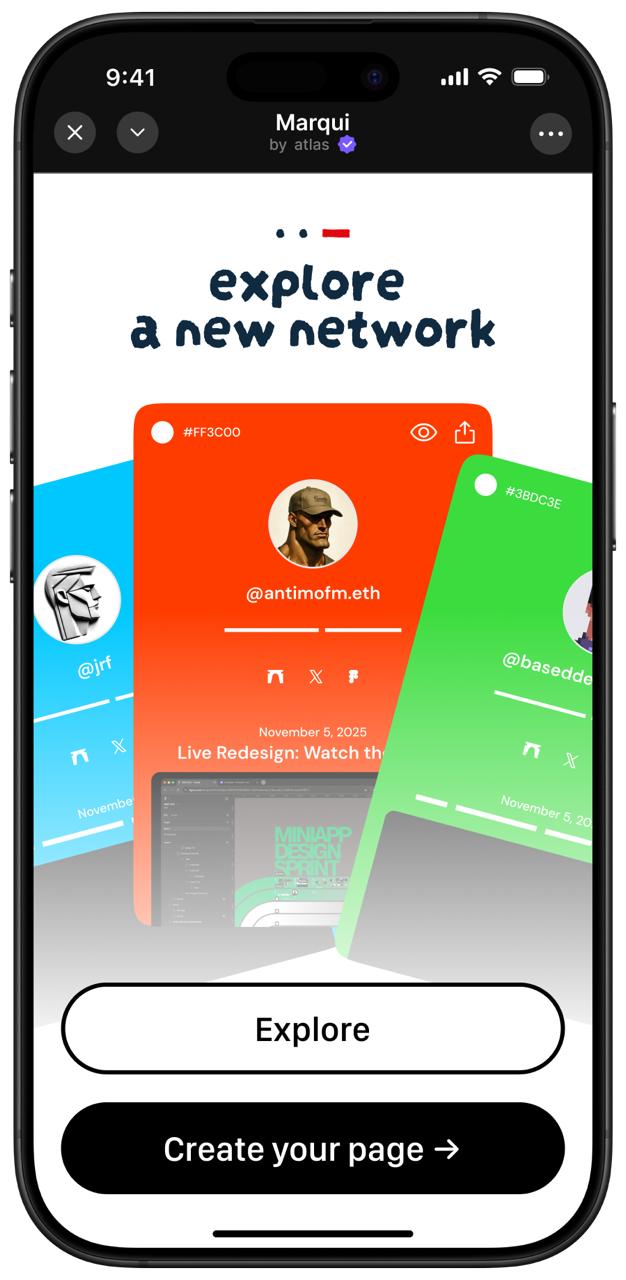
In the old web, visiting every site was a chore. In the “Feed” web, surviving the noise is a chore. In the Marqui web, agents (AI) facilitate the connection. They enable your site to bring the world in selectively, not indiscriminately.
We aren’t building a new social network. We are building a protocol for Intentional Identity.
Thanks for reading. We’re still navigating the mind maze, and we’re glad to have you with us.
Join the Conversation
This post originated as a thread on Farcaster.